Sermon by Pastor Mike Buttonnn
Were you there?
Text: Mark 14: 51, 52
NRS Mark 14
51 A certain young man was following him, wearing nothing but a linen cloth. They caught hold of him, 52 but he left the linen cloth and ran off naked.
Sisters and Brothers in Christ, may the Lord grant us the strength and give us the faith to follow in the steps of Jesus the Messiah. Amen.
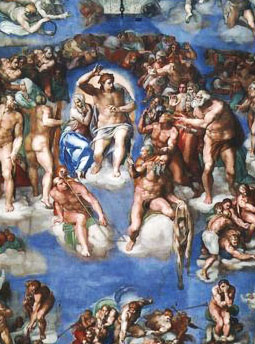
In Michelangelo’s painting of the Last Judgment, he includes a portrait of St. Bartholomew. He’s holding a knife in his hand and his own skin hangs over his arm, because, legend has it, that he died a martyr by first being skinned alive and then crucified upside down. [And by the way, that’s also how Bartholomew came to be the patron saint of tanners. Go figure!] But scholars say that if you look closely at the skin Bartholomew is holding, you’ll see that Michelangelo has painted his own face onto St. Bart’s hide. After seven years of painting the same picture, maybe that’s how the great artist felt, or maybe that’s how he saw himself coming before God – the bare skin of a man hanging over the abyss, saved from hell by the sacrifice of another.
Some people claim that the author of St. Mark’s Gospel has done the same thing in his telling of our Lord’s Passion, painting himself into the story of Jesus’ suffering and death. You may remember that after Jesus is betrayed and arrested in Gethsemane, Mark, and only Mark, tells us that a young man wearing nothing but a linen cloth follows Jesus as he is being led away. When Jesus’ abductors try to grab him, he drops the linen cloth and runs away naked. We’re not told who this guy is, or where he came from, or why he’s only wearing a linen cloth. And really, what’s a naked man doing running across the pages of our Lord’s march to the cross? It’s a very strange detail that doesn’t seem particularly relevant to the story, and if Mark really was the first gospel committed to writing, it’s a detail that neither Matthew nor Luke thought important enough to include in their accounts.
If Mark has written himself into Jesus’ story, then the evangelist has portrayed himself as a frightened young man, stripped of his clothing and his faith. Nobody knows, of course; anymore than anybody really knows who Mark was in the first place. Tradition identifies Mark as an associate of St. Peter who composed his gospel based on the things he learned from that apostle. Which could very well be true, but like all the other gospels, the author of “Mark” never actually names himself, except for maybe this bizarre little story about a man failing the ultimate test of discipleship.
Even if we’re not Michelangelo or St. Mark, I guess we’re always projecting ourselves into the books we read, the movies we watch, even the music we hear. Most of us have indulged a fantasy or two about playing air guitar to a stadium of raving fans, or maybe standing before a great orchestra with baton in hand. Every generation comes up with its own action heroes and romantic heroines, characters through whom we live out our dreams of saving the day, winning the big one, or going home with the prom king or queen. But in reading the Passion of Our Lord, it’s not so easy to give in to our heroic impulses. There is, I suppose, a part of us that would like to identify ourselves with Jesus, nobly suffering, faithfully enduring, selflessly sacrificing. But there’s a much bigger part of us that knows better, and in the story of our Lord’s progress to the cross, there are so many other people that actually look and act like us.
I’d like to think of myself as the woman who anointed Jesus, but I know I’d probably be more like the ones who complained about the waste and the cost and how that ointment could have been sold and given to the poor. Then there’s Peter with all his big talk before the cock crows twice. I could play that role pretty convincingly. Then there’s Peter again joined by James and John, asleep in Gethsemane while Jesus agonizes. Been there, done that. Then, too, there’s Pilate, passing the buck and caving in to the crowd. Sound familiar? There’s also Barabbas, the criminal freed in place of the innocent man. Think how many times have you have stood at the graveside of a child, friend, loved one, and not wondered, “Why not me? Why am I still here?” Of course, nobody likes to put themselves in the place of Judas, but what about Simon of Cyrene, the poor guy forced to carry our Lord’s cross? How often are we dragged to the cross, kicking and screaming, compelled against our wills and complaining all the way? And let’s not forget about all those throngs of angry people, waving their fists and wagging their fingers, faces in the crowd, bricks in the wall.
Which brings me back to that poor little fellow running bare-bottomed away from Jesus and his rendezvous with the cross. Some commentators think that Mark intends him to be a symbolic counterpoint to that other young man dressed in white, the one who greets the women from the empty tomb on Easter morning to tell them that Jesus is not there. Or he could be Mark’s own funny-sad self-portrait, woven into the vast tapestry of characters playing their roles in the drama of our Lord’s Passion. Or he could be you, or me: wanting to follow, but wanting more not to get in trouble; robed in Christ, but only very lightly so; trying to be faithful, but still easily frightened; fleeing the one man, the one Lord, the one Savior he so desperately needs. Yeah, I can see that.
In the Name of the Father, and of the + Son, and of the Holy Spirit. Amen.