Sermon by Pastor Mike Buttonnn
You, Me, and Alexamenos
Text: John 12: 20-33
NRS John 12
20 Now among those who went up to worship at the festival were some Greeks. 21 They came to Philip, who was from Bethsaida in Galilee, and said to him, "Sir, we wish to see Jesus." 22 Philip went and told Andrew; then Andrew and Philip went and told Jesus. 23 Jesus answered them, "The hour has come for the Son of Man to be glorified. 24 Very truly, I tell you, unless a grain of wheat falls into the earth and dies, it remains just a single grain; but if it dies, it bears much fruit.
25 Those who love their life lose it, and those who hate their life in this world will keep it for eternal life. 26 Whoever serves me must follow me, and where I am, there will my servant be also. Whoever serves me, the Father will honor.
27 "Now my soul is troubled. And what should I say-- 'Father, save me from this hour'? No, it is for this reason that I have come to this hour. 28 Father, glorify your name." Then a voice came from heaven, "I have glorified it, and I will glorify it again." 29 The crowd standing there heard it and said that it was thunder. Others said, "An angel has spoken to him." 30 Jesus answered, "This voice has come for your sake, not for mine. 31 Now is the judgment of this world; now the ruler of this world will be driven out. 32 And I, when I am lifted up from the earth, will draw all people to myself." 33 He said this to indicate the kind of death he was to die.
May the blessing of the Lord rest and remain upon you always, for the sake of Jesus the Messiah. Amen.
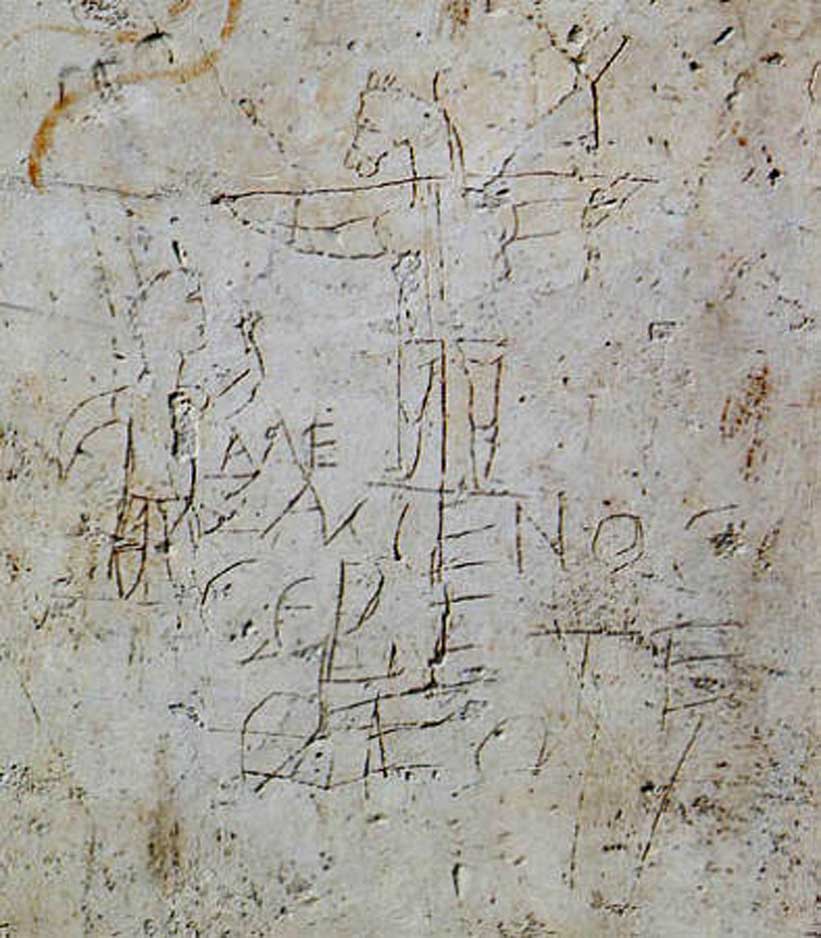
The singular form of graffiti is graffito, and this is a picture of what
archaeologists call the Alexamenos graffito. I know, it’s not very clear but I’ll take care of that in a minute. This is carved into a plaster wall found near the Palatine hill in Rome, and dates from somewhere between the first and third centuries a.d. If Wikipedia is to be believed (and who doesn’t?), this is alleged to be among the earliest representations of the crucifixion of Jesus.
In an archaeological tracing, both the figures and the writing come into much better focus. First one, and then another:
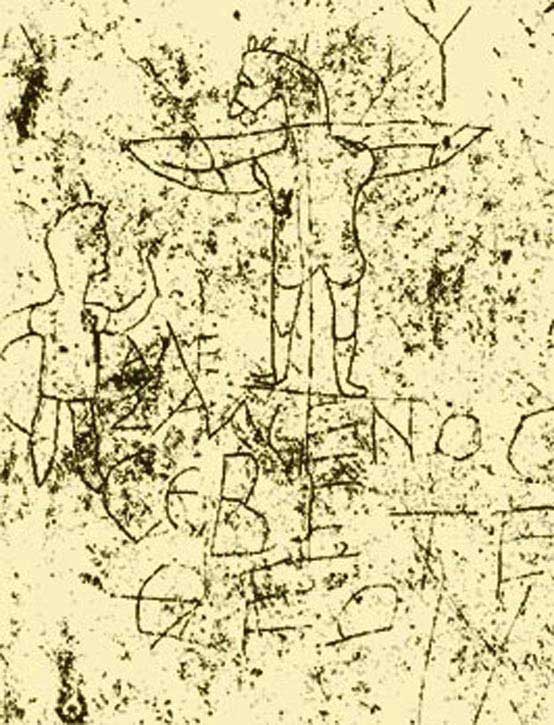
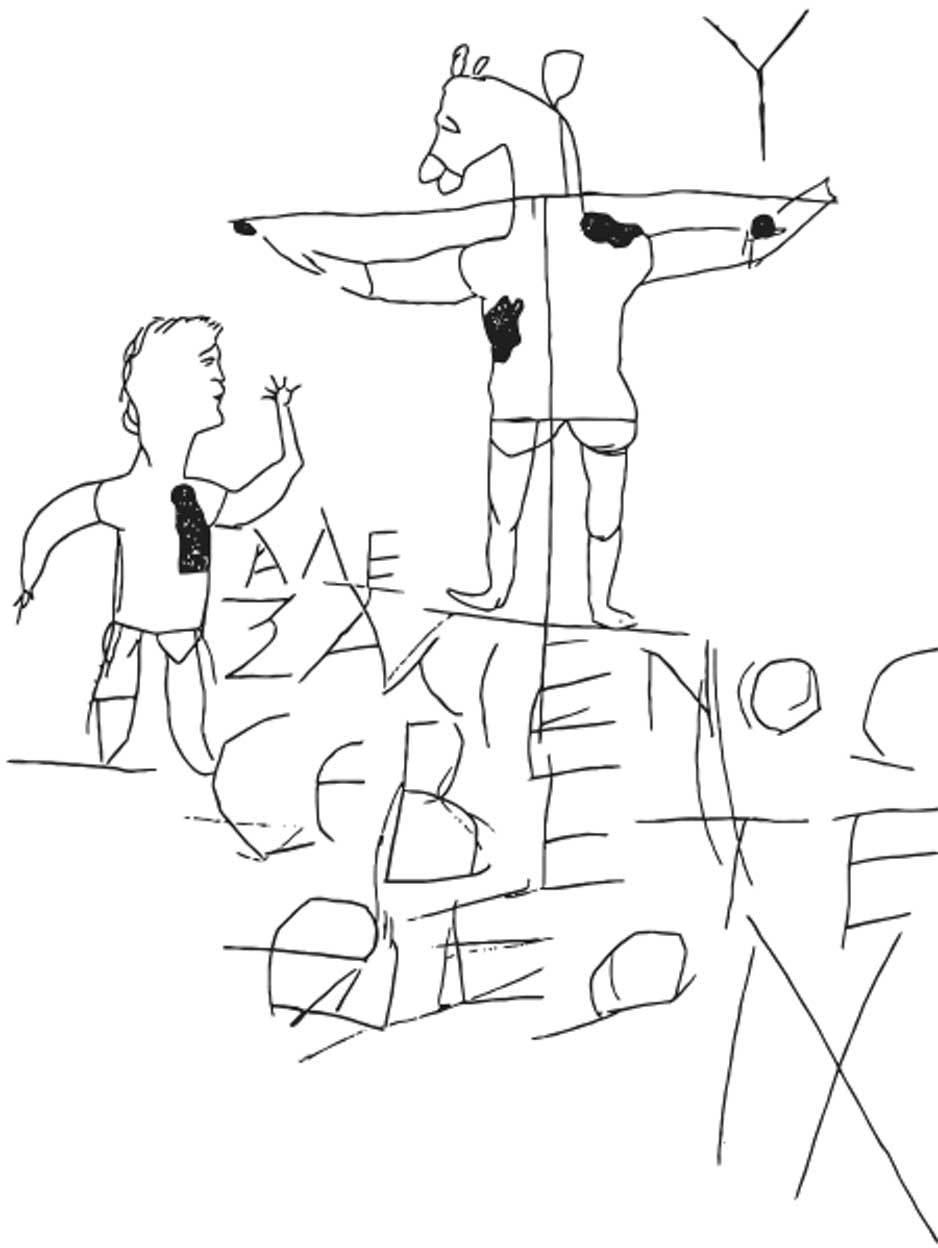
In the center is a human figure with the head of a donkey spread out on a cross. Guess who that might be? To the left is another figure with his right hand raised, possibly in a gesture of worship. The Greek writing spells out first the name Alexamenos, then the two words sebete theon, meaning, literally, “worship God.” Some scholars think it could also be, sebetai theon, which translates as “worships God.” Personally, I think it’s a scribble from a Latin-speaking kid who was flunking Greek grammar. But put it all together, it says, more or less, “Alexamenos worships his god.” The joke, or the blasphemy, depending on your point of view is that Alexamenos is so stupid that he worships an even more stupid god who got himself crucified.
This is an incredible window on what it was like to be a Christian in those early centuries. If people weren’t trying to kill you, they were making fun of you for worshiping a God with the sense of a donkey. This piece of playground blasphemy also illustrates what those early Christians were up against in trying to make themselves understood. As those first saints were proclaiming Jesus Lord, the non-Christian world was also asking them, “If Jesus is the Son of God, capable of miraculous powers and divine wisdom, then how did he end up on a Roman cross?” Two thousand years later, the non-Christian world asks us much the same: “Why did Jesus have to die, and die such a horrible, humiliating death?” Over the centuries we’ve been trained to answer automatically, “Jesus died for our sins,” but the world has this nasty habit of asking back, “Well, couldn’t God have couldn’t have come up with a better, less bloody solution? Couldn’t God have just declared, ‘Okay, everybody’s sins are forgiven. Be good, play nice, and share your toys.’” The fact is, we ask ourselves: “If it’s true that for God nothing is impossible, then how come the only Son must suffer, die, and be buried before rising again in glory?”
In today’s gospel we hear the evangelist John drawing on the words and wisdom of Jesus to respond to those questions. Of course, all of the gospels and likewise the apostle Paul take up the challenge of the cross, but John’s gospel does so in a unique way, some features of which we hear in this morning’s gospel. You may remember way back to the beginning of John’s gospel when Jesus’ mother asks him to replenish the wine at the wedding feast at Cana, Jesus tells her, “My hour has not yet come” (2:4). As mother’s are wont to do when their sons demur, Mary ignores Jesus’ response, but when Jesus actually does change the water into wine, remember that he does so more or less undercover. Only the servants and his disciples see what’s going on. That’s because in John God’s plan of salvation operates on a very strict timetable. It has to be the right hour for the cross and resurrection to be effective. Consequently, “My hour has not yet come” is something Jesus says at least six times in John’s gospel until here when he finally declares, “The hour has come for the Son of Man to be glorified” (12:23). So why just then? What’s happened that Jesus now says, “This is the time?”
Commentators see a connection between Jesus’ declaration and the arrival of a delegation of Greeks asking to see him. Who are these Greeks? We don’t know, but apparently Jesus’ fame and reputation had grown to the point that outsiders were now seeking him out. For Jesus, it’s like an alarm went off inside his head, alerting him that a critical mass had been reached and things have been set in motion that cannot be stopped or reversed.
I want also to make a point I’ve mentioned before, but, as you well know, that’s what pastors do. We make the same point over and over and over again, but in this case, it’s a point that’s actually based in the text. Notice here how cross and resurrection are virtually inseparable. When Jesus says, “The hour has come for the Son of Man to be glorified,” his glorification means both his death and his resurrection. Likewise, when Jesus speaks of being “lifted up from the earth,” that phrase has the double meaning of his being lifted up on the cross, but also his being lifted up from death and raised to the Father’s right hand. This why I so often harangue you about observing the whole Three Days of Maundy Thursday, Good Friday, and Easter Sunday. What’s important to our faith is not either the cross, or the empty tomb, but rather, it’s God’s whole action in both cross and resurrection that comprise our salvation.
John’s gospel works like wheels within wheels within wheels. In the raising of Lazarus that precedes today’s lesson, one wheel turns locking in the opposition that will send Jesus to the cross. And now as these unnamed Greeks come seeking Jesus, another wheel turns that sets the stage for both cross and resurrection to be the ultimate sign for God’s reconciling justice. That , I think, is the main point to Jesus’ illustration of the grain needing to die in order to bear much fruit. I don’t think Jesus is making a big, global, philosophical point about how life comes out of death, or how the night precedes the dawn, or winter chill before spring thaw. Rather, Jesus’ point is that his specific death is the door, the gateway, the portal through which the Father’s power, glory, and total commitment to the salvation of the world are revealed in a way that is once and for all, unrepeatable and irreversible.
Something you don’t find so much in John is the language of sacrifice for sin. In Matthew and Mark Jesus dies as a “ransom for many” (Matthew 20:28; Mark 10:45). In the Letter to the Romans St. Paul writes of God putting Jesus forward as an “expiation” (RSV) or “sacrifice of atonement” (NRSV) (3:25). John’s gospel likewise affirms Jesus’ life-giving death, but with a little different spin. In the very first chapter of John’s gospel remember how John the Baptist John hails Jesus as “the Lamb of God who takes away the sin of the world” (John 1:29). You may also recall how in John Jesus is not killed on Passover itself (as in Matthew, Mark, and Luke), but instead, Jesus dies on the Day of Preparation, when lambs were slaughtered in the Temple for the next day’s Passover meal. These lambs weren’t killed as a sacrifice per se, but the blood of those lambs was ritually applied to the doorposts of Jewish households, recalling how Moses instructed the Israelites to mark their own homes to ward off the angel of death. So in John’s gospel Jesus does not shed blood to satisfy the anger and wrath of his Father, or that he should be the ransom paid to the devil for our deliverance. Rather, Jesus takes away the sin of the world by marking us for eternal life, sparing us the wages of sin, so that in, with, and through his blood we may know the love that not even death can kill.
Long before the wags and pundits of ancient Rome were making fun of Christianity, Christians themselves knew that their faith in Jesus was kind of crazy. Paul described the cross of Jesus as a God’s foolishness (1 Corinthians 1,2). In Matthew, Jesus gives thanks to his Father in heaven that “you have hidden these things from the wise and intelligent and have revealed them to infants” (11:25). But for many of us, the words of Jesus and the teachings of the church have become such a part of our mental furniture that we’ve forgotten what a strange and alien wisdom it is that we find in the gospel. The early church father Tertullian took up the cross’ folly as his badge of honor. He declared that he didn’t believe because the gospel made sense, or that it was rationally compelling, or that it satisfied the demands of Aristotelian logic; he said, instead, “Credo, ut absurdum,” that is, “I believe, because it is absurd.” I believe because it flies in the face of common sense. I believe because it turns this world’s wisdom inside out. I believe because only God would come up with this kind of plan. Only God would so intentionally invert the power structures and ideologies of this present order. Only God would, only God could turn a cruel joke into an emblem of our salvation.
In the Name of the Father, and of the + Son, and of the Holy Spirit.
Amen.