NRSJohn 8
31Then Jesus said to the Jews who had believed in him, "If you continue in my word, you are truly my disciples;32and you will know the truth, and the truth will make you free."33They answered him, "We are descendants of Abraham and have never been slaves to anyone. What do you mean by saying, 'You will be made free'?"
34Jesus answered them, "Very truly, I tell you, everyone who commits sin is a slave to sin.35The slave does not have a permanent place in the household; the son has a place there forever.36So if the Son makes you free, you will be free indeed
.
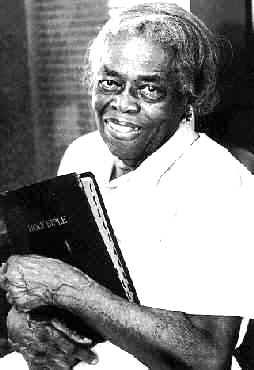
This woman’s portrait should hang in every statehouse across this country, right alongside Washington’s and Lincoln’s. Her picture ought to be on prominent display in every school and institution of higher learning throughout these United States, with a pedestal beneath it on which fresh flowers are placed daily. Her story should be told in every child’s textbook of American history. I’d put her face on a stamp, and since I’ve never been a big fan of Andrew Jackson, I’d also put her on the $20 bill. By God, if she were alive today, I’d vote for her to be President.
Her name is Oseola McCarty. She was born in Wayne County, Mississippi, and as a child moved with her mother to Hattiesburg. She left school in the sixth grade to attend to an infirm aunt. Like her grandmother and mother before her, she made a living as a washerwoman, cleaning and pressing clothes for many of Hattiesburg’s elite families. In 1947, her uncle left her the little house where she lived and worked until the day she died. She never married, never owned a car, but she did have a shopping basket that she used to cart her groceries from the Big Star food market about a mile from where she lived.
With more in the bank, or more in my wallet, or more under the mattress, it’s more tempting for me to believe that I don’t have to put all my eggs in the Lord’s basket. And even when those resources are less than robust, it’s just as easy to tell myself, “Well, I’ve got my health. I’ve got my education. I’ve got my family to fall back on.” But whether we have two dollars or two million, whether we have a Ph.D. or a GED, we are no less dependent on the same grace and mercy as the widow at the Temple. Whatever we may have in wealth, health, or character, nothing we can possess or control changes the equation of our complete reliance on the Lord’s goodness.
As a child she got in the habit of setting a little something aside every time she got paid for her cleaning duties. She said, "I would go to school and come home and iron. I'd put money away and save it. When I got enough, I went to First Mississippi National Bank and put it in. The teller told me it would be best to put it in a savings account. I didn't know. I just kept on saving." Over the years, the people at the bank noticed that Miss Oseola was building up a handsome little nest egg, and they helped her move that money into CD’s, conservative mutual funds, and some other accounts where her savings could better work for her. Her arthritis started to get the best of her and at age 86 she had to give up her washing and ironing. About that time the bank’s senior trust officer arranged a meeting with Miss Oseola and her attorney, a man whose laundry she’d done since he was a little boy. Alerted to Miss Oseola’s growing accounts by the cashiers with whom she worked, the banker asked her what she wanted to do with her savings. Did she want to travel? Buy a new home? Finally get a car? She explained, “After my aunt died, I began to think, I didn't have nobody. I began to think about what to do with what little I had. I wanted to leave some to some cousins and my church. But I had been thinking for a long time ... since I was in school ... I didn't know how to fix it, but I wanted to give it to the college (USM). They used to not let colored people go out there, but now they do, and I think they should have it."
In July of 1995 the University of Southern Mississippi announced that Miss Oseola McCarty had endowed a scholarship fund for financially needy students of African-American descent in the amount of $150,000. While Miss McCarty had never actually been on the Southern Miss campus, she said, “I just want it to go to someone who will appreciate it and learn. I'm old and I'm not going to live always." When news of her gift made the news, nearly 600 donors matched her donation by another $330,000. When media mogul Ted Turner learned of Miss McCarty’s generosity, he pledged $1 billion of his $3 billion fortune to U.N. related causes around the world. Of course, the University of Southern Mississippi bestowed on her an honorary doctorate, and in 1996 Harvard University did the same. In 1998 President Clinton invited her to the White House for her first trip out of the Deep South in 50 years, and in a ceremony co-sponsored by the President and the congressional black caucus, she was awarded the Presidential Citizens’ Medal.
Miss Oseola McCarty was treated for colon cancer only for the disease to reappear in her liver. She wanted to spend her last days in the house her uncle had left her so many years before. She told a visitor, “I don't want to close my eyes because I don't know if I'll open them again. But I am not afraid." She passed at the age of 91, the most famous benefactor in the history of the University of Southern Mississippi, an American hero who inspired millions, and the best darn stewardship sermon any pastor could ever hope to preach.
Seriously, if you don’t get the concept of stewardship after hearing this lady’s story, then there’s not much chance that anything more I might say now will make much of a difference. The whole message of Christian stewardship is wrapped up in this woman’s life. Was her giving sacrificial? Check. Was her giving proportionate, as in way out of proportion to what anybody would have ever imagined? Check. Was her giving systematic and planned in advance? Check. And by the way, it’s no accident that the book she holds over her heart in this picture is the Holy Bible. She knew the Word and she lived it.
We mostly live, work, and go to school in large, integrated systems that make it easy for us to feel like cogs in a machine. Some days we wonder if what we’re doing matters to anyone. Is anybody paying attention? Does anyone care? Many people feel hemmed in on every side, held in check by family pressures, financial pressures, social and political pressures about which they feel helpless. Christ came to set us free, but there are times we wonder, “Free how? Free where? Free when?” Then the Lord raises up a saint like Miss Oseola whose witness reminds us, “Free here.Free now. Free against all odds.” Glory, glory, hallelujah!
In the Name of the Father, and of the + Son, and of the Holy Spirit. Amen